The Four Iranian Pistachio Varieties — and Which One Belongs in Your Market
Akbari, Ahmad Aghaei, Kalleghouchi and Fandoghi are not four names for the same nut. They differ in shape, in the size range they can physically reach, in shell colour, and — increasingly — in whether they will still be planted a decade from now.
An enquiry lands in our inbox most weeks that reads more or less like this: "One 20-foot container of Iranian pistachios, 22/24, best quality, CIF Jebel Ali." It is a reasonable request. It is also incomplete, because that specification can be filled with at least three different varieties, and those three will not look the same when the container doors open, will not roast the same way, and will not carry the same price.
Variety is the first line of a pistachio specification — ahead of size, ahead of shell form, ahead of preparation. Get it wrong and everything downstream is wrong with it. What follows is a working guide to what Iran's orchards actually produce and how to read it as a buyer rather than as an agronomist.
Shape index: the one technical term worth learning
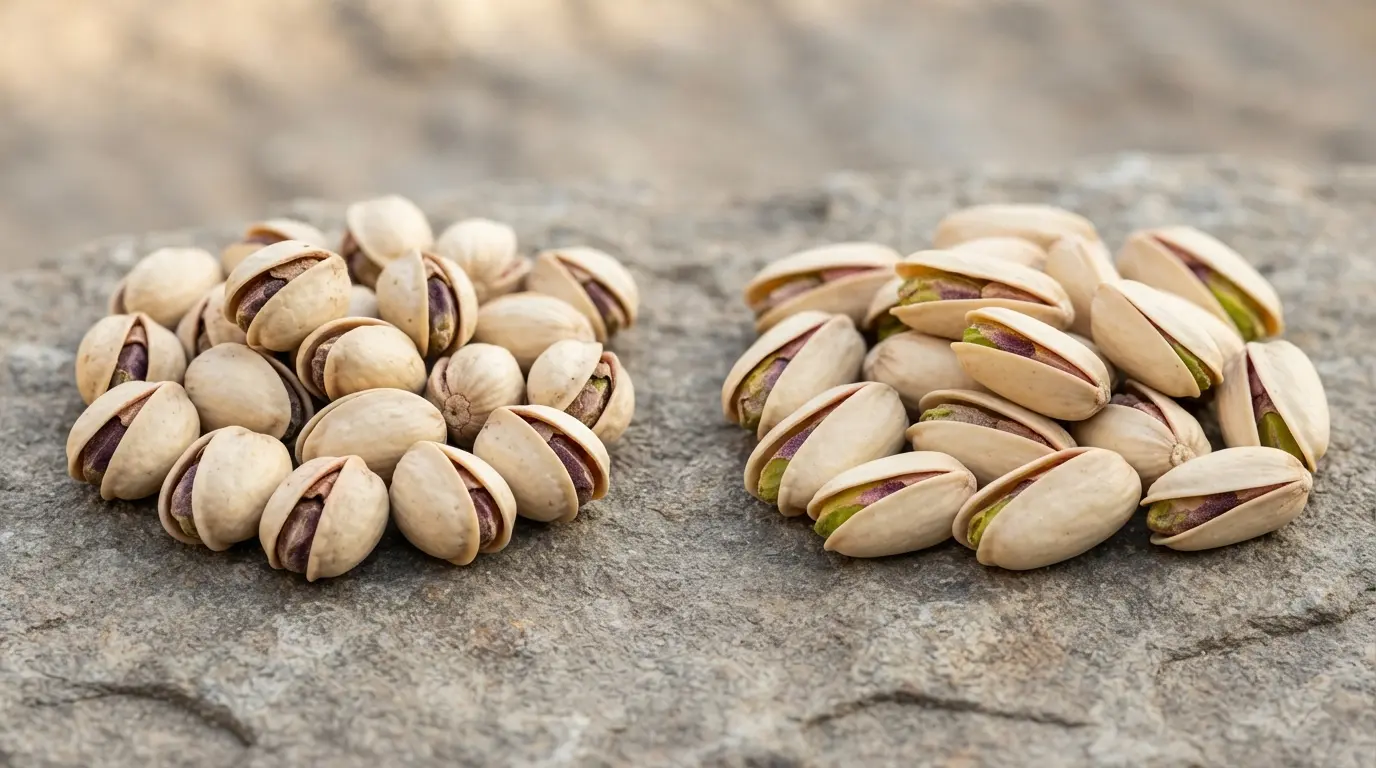
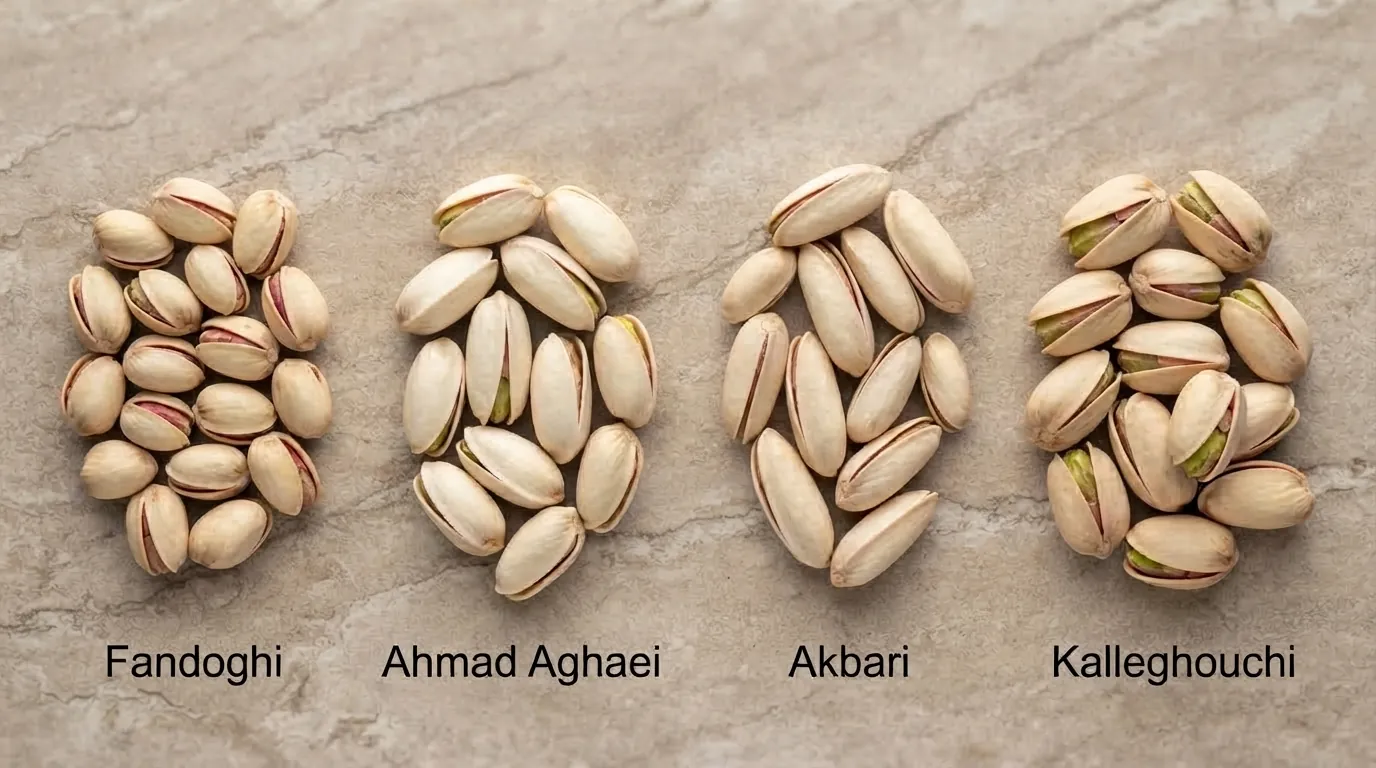
Iranian pistachios are classified commercially into two families, round and long, and the dividing line is a ratio called the shape index — the length of the nut divided by its width. Fandoghi sits at the bottom of that scale and is visibly round. Ahmad Aghaei sits just above 1.5. Akbari has the highest shape index of the four commercial varieties, which is another way of saying it is the longest pistachio Iran grows.
This is not a cosmetic detail. Shape drives how a nut sits in a retail pouch, how it photographs on a shelf, how efficiently it packs into a carton, and — in most consumer markets — how expensive it looks. It also sets a ceiling on size, which is the point most buyers discover the hard way.
Fandoghi (Round) — the volume variety
Fandoghi is the most widely cultivated pistachio in Iran and accounts for roughly half of current national production. It is grown across every pistachio-producing region, which is precisely why it is the variety least likely to leave you short mid-contract. Commercial sizes run 28/30, 30/32 and 32/34 nuts per ounce, with 26/28 available in limited quantities in a good year.
It is a small nut and it is priced accordingly. That is not a defect — it is the reason Fandoghi dominates the channels where the pistachio is eaten rather than displayed: roasted-and-salted snack packs, kernel production, industrial processing, and price-led volume programmes. If your buyer is going to shell it, grind it, or sell it by the kilo from a bulk bin, Fandoghi is usually the correct answer and paying for a longer variety is money spent on something nobody will see.
The trade-off is straightforward: Fandoghi will not carry a premium gift box, and no amount of polishing will make it look like one.
Ahmad Aghaei — the export workhorse
Ahmad Aghaei is the newest of Iran's four commercial varieties and the one gaining ground fastest. It is a long nut with a shape index just above 1.5, and it carries the whitest shell of the four — which matters more commercially than it sounds, because buyers and end consumers both read shell colour as a proxy for freshness. Sizes run 22/24, 24/26, 26/28 and 28/30, with 20/22 appearing in limited volume.
Growers like it because it comes into commercial bearing faster than the older varieties and yields more per tree. That is why it is steadily replacing Kalleghouchi in new plantings, and why availability in this variety is the most comfortable of the four over a multi-year supply agreement. It has a particularly strong following in India and Greece.
One caution that rarely appears in supplier literature: the same whiteness that makes Ahmad Aghaei attractive also makes it unforgiving. Shell staining, hull residue and handling marks show up on an AA lot far more visibly than on a Fandoghi lot with the identical defect percentage. If you buy Ahmad Aghaei, inspect on appearance as well as on the spec sheet.
Akbari — the long premium nut
Akbari has the highest shape index of any Iranian commercial variety: it is the longest nut in the catalogue, and it is the one most often specified where the pistachio itself is part of the presentation. Sizes are 20/22, 22/24 and 24/26, with 18/20 available in small quantities.
Akbari is also reported to be the easiest of the four to open by hand. That sounds like a triviality and is not. In the Gulf snacking market, where pistachios are served in bowls at gatherings and eaten continuously rather than portioned, an easy-opening nut is consumed faster and reordered sooner. Buyers in that channel notice, even if they never articulate why.
It is a newer variety with good yields and it is being planted more each season, so unlike Kalleghouchi it is not a supply risk. Expect to pay for the length.
Kalleghouchi (Jumbo) — the giant that is quietly disappearing
Kalleghouchi is the classic Iranian jumbo: a round-type nut with the largest size ceiling of the four, sold as 20/22, 22/24 and 24/26, with 18/20 in small quantities. For decades it was the variety that defined "Iranian pistachio" in premium markets.
The commercial reality has changed, and any buyer planning a multi-season programme should know it. Kalleghouchi production is in decline. The existing trees are largely over forty years old and effectively no new Kalleghouchi orchards are being established — growers replanting today are choosing Ahmad Aghaei and Akbari for their faster returns and higher yields.
The practical consequence: Kalleghouchi is a variety to contract early in the season, ideally before the harvest is fully graded, and not one to go shopping for in month eight when the good lots have already moved. If your programme depends on it, secure it in writing with a specified crop year.
The four varieties at a glance
Variety | Shape | Commercial sizes (nuts per ounce) | Shell | Supply trend | Best fit |
|---|---|---|---|---|---|
Fandoghi (Round) | Round; lowest shape index | 28/30, 30/32, 32/34 (26/28 limited) | Standard cream | Stable — about half of Iranian output | Kernel production, roasted snack, volume programmes |
Ahmad Aghaei | Long; index just above 1.5 | 22/24, 24/26, 26/28, 28/30 (20/22 limited) | Whitest of the four | Expanding — favoured in new orchards | Retail packs, India, general export |
Akbari | Long; highest shape index | 20/22, 22/24, 24/26 (18/20 limited) | Standard cream | Expanding | Premium retail, gift packing, Gulf snacking |
Kalleghouchi (Jumbo) | Round; largest size ceiling | 20/22, 22/24, 24/26 (18/20 limited) | Standard cream | Declining — ageing orchards, no replanting | Jumbo display, gift boxes, appearance-led buyers |
Size ranges reflect what is available in commercial volume. Every variety produces a few nuts outside its normal band; that is not the same as being able to buy a container of them.
Matching the variety to the destination market
The right variety is a function of what happens to the nut after it clears customs, not of which one is objectively "best". Below is how the four typically distribute across the markets we ship to.
Variety by destination market
Market | Usual choice | Why, and what to watch |
|---|---|---|
GCC and Iraq | Akbari and Kalleghouchi; Ahmad Aghaei for mid-tier retail | Appearance-led market. Pistachios are served openly at gatherings, so size and ease of opening both matter. Demand is strongly seasonal around Ramadan and Eid — book in the third quarter for first-quarter delivery, because the good jumbo lots are gone by then. |
India | Ahmad Aghaei, plus Fandoghi for processing | Ahmad Aghaei has genuine name recognition in the Indian trade and moves without explanation. Fandoghi and kernels feed the confectionery and mithai channels. |
China | Kalleghouchi and Akbari, 22/24 and larger | Size before almost everything else, driven by gift-box retail around Lunar New Year. Small sizes are a hard sell regardless of quality. |
Russia and CIS | Fandoghi and Ahmad Aghaei | Roasted-and-salted snack channel, price-led, bought on cost per kilo rather than on appearance. Fandoghi does very well here. |
Europe | Fandoghi and Ahmad Aghaei, often as kernel | Variety is a secondary question in most European enquiries. The gating factor is documentation — aflatoxin results, traceability, and consistency between the lab report and the container. |
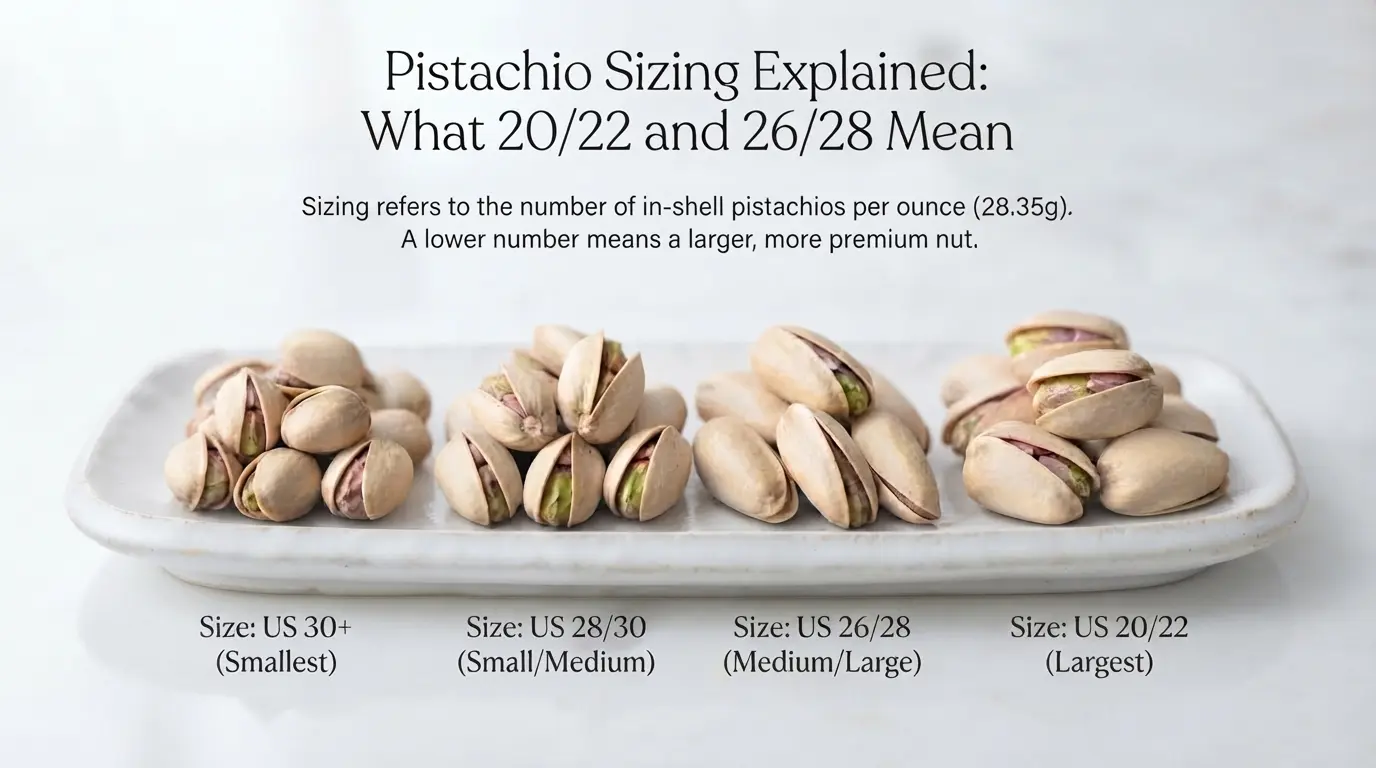
A correction worth making. A number of exporter websites — including some large ones — describe sizes such as 22/24 as "kernels per pound". They are not. The convention is the number of whole in-shell nuts in one ounce (28.35 g). A 22/24 lot holds roughly 776 to 847 nuts per kilogram. If a supplier's own site has the unit wrong, it is fair to wonder what else on the spec sheet is copied rather than checked. |
What to put in the enquiry
A specification that gets a firm, comparable quote on the first exchange contains six lines. Anything less and you will get a price that quietly assumes the cheapest interpretation.
Variety — Akbari, Ahmad Aghaei, Kalleghouchi or Fandoghi, named explicitly.
Size — as a count per ounce, for example 22/24. If you can accept an adjacent band, say so; it can move the price meaningfully.
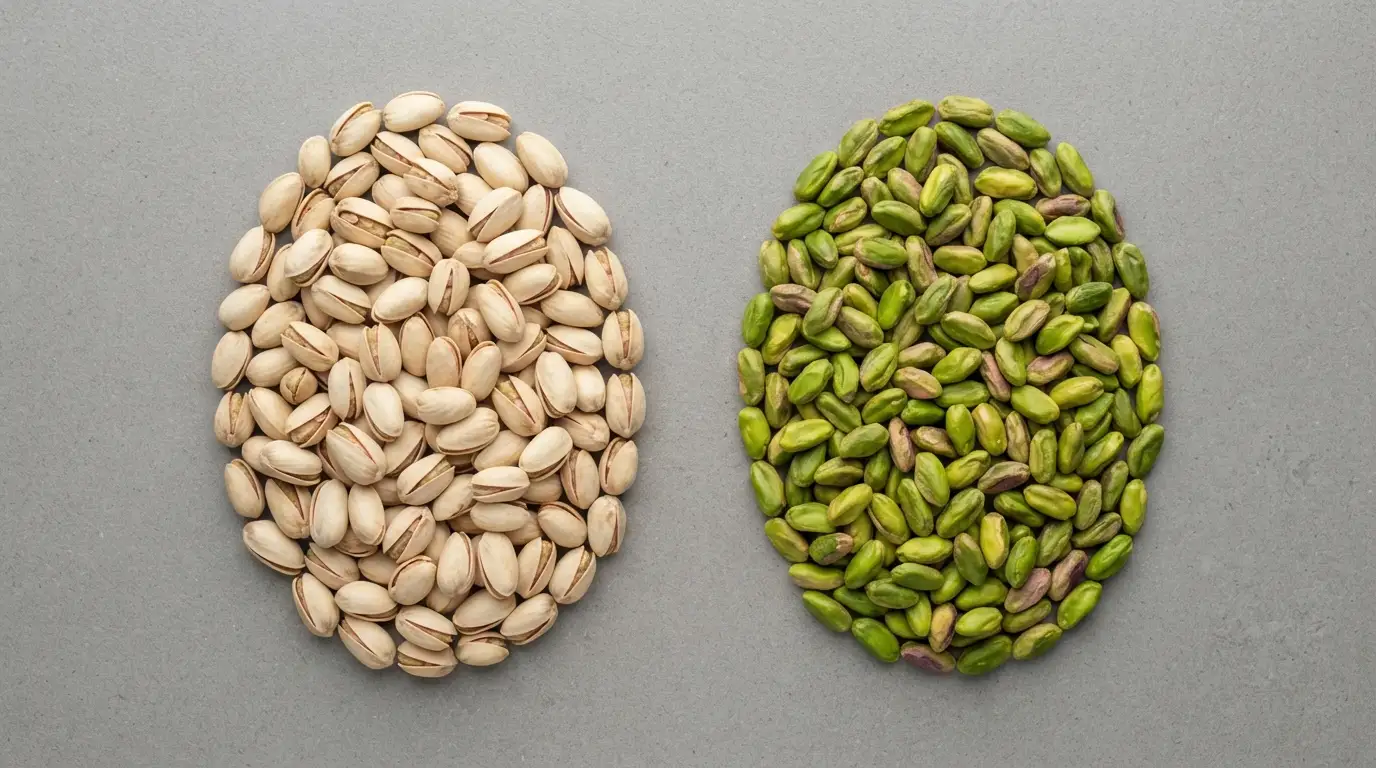
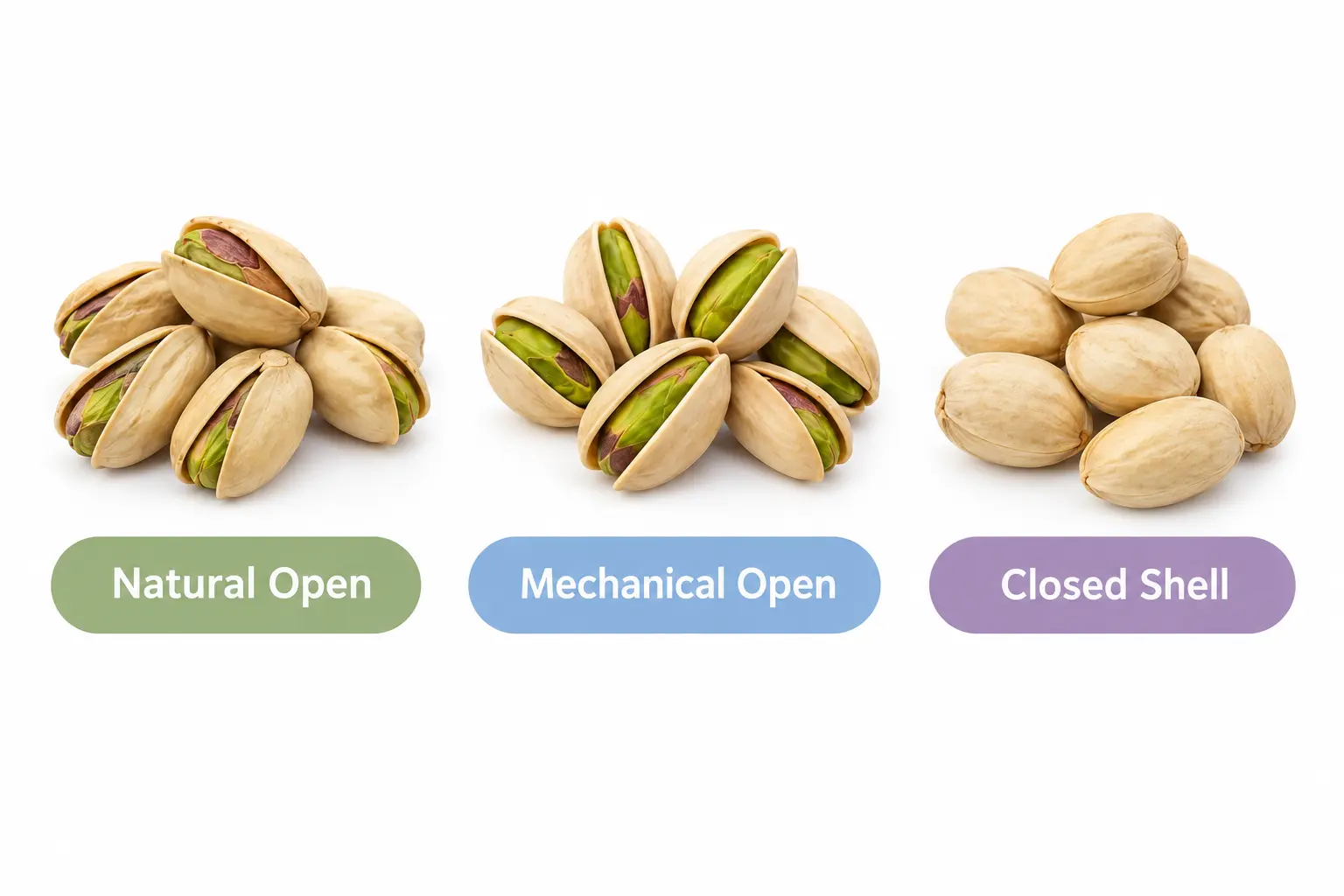
Shell form — naturally open, mechanically opened, or closed shell. This is a larger price variable than most buyers expect and is covered in its own guide.
Preparation — raw, roasted, or salted and roasted. Salted product has different moisture behaviour and a different shelf life.
Crop year — always. A new-crop and a carry-over lot of the same variety and size are not the same product.
Packaging — vacuum cartons or woven bags, and the net weight per unit. This determines pallet configuration and container fill.
Three mistakes we see regularly
Asking for a size the variety cannot produce
Requests for 20/22 Fandoghi arrive several times a season. Fandoghi does not reach that band in commercial quantity — the variety is physically smaller. A supplier who accepts that order without comment is either about to substitute the variety or about to send you a heavily cherry-picked lot at a price that will not repeat.
Treating "jumbo" as a size
In Iranian trade usage, Jumbo is a name for Kalleghouchi, not a size class. "Jumbo 30/32" is a contradiction. If a quote contains that phrase, clarify before you compare it against anything else.
Leaving Kalleghouchi until late in the season
Given the state of the orchards, the large-size Kalleghouchi lots are allocated early. Buyers who tender for jumbo in the second half of the season routinely find that the price has moved and the sizes on offer have shifted a band smaller.
The short version
If the nut will be displayed, buy long or buy jumbo: Akbari for length and ease of opening, Kalleghouchi while it lasts for sheer size. If the nut will be eaten, processed or shelled, Fandoghi will do the same job for less. Ahmad Aghaei sits between the two and is the safest single choice for a buyer who needs one variety to cover a mixed customer base — which is why it is the variety Iran is planting.
Questions buyers ask
Which Iranian pistachio variety is the largest?
Kalleghouchi, sold commercially as Jumbo, has the largest size ceiling and reaches 18/20 in small quantities. Akbari reaches the same size bands but is long rather than round, so a 20/22 Akbari and a 20/22 Kalleghouchi weigh the same per nut while looking quite different.
What is the difference between Akbari and Ahmad Aghaei?
Both are long varieties. Akbari is longer, reaches larger sizes (20/22 upward), and is easier to open by hand. Ahmad Aghaei is slightly smaller, has a whiter shell, is more widely available, and generally costs less. For premium gift packing, Akbari. For consistent year-round retail supply, Ahmad Aghaei.
Is Fandoghi lower quality than the other varieties?
No. It is a smaller nut, which is a size characteristic rather than a quality grade. Quality is measured by moisture, defect percentage, closed-shell content and aflatoxin result — and a well-processed Fandoghi lot will outperform a poorly handled Akbari lot on every one of those.
Can I mix varieties in one container?
Yes, and it is common. Specify the split by variety, size and net weight per line, and ask for the lot to be palletised and marked by line so the container can be checked against the packing list without unstacking it.
Which variety should I buy for kernel production?
Fandoghi, in most cases. The economics of kernel production are driven by kernel weight recovered per kilogram of in-shell input and by shelling cost, not by the appearance of the shell — so paying a premium for a long variety you are about to discard makes no sense.
How far ahead should I contract?
The Iranian harvest runs from late summer into autumn. For jumbo sizes and for Kalleghouchi specifically, contract before or immediately after harvest. For Fandoghi and Ahmad Aghaei in mid sizes, availability is comfortable for most of the year.
Ready to place an enquiry? Contact our export team for a firm quotation on this specification.