The Six Pistachio Kernel Grades and What Each One Is Actually For
Ordering "pistachio kernels" without naming a grade is like ordering "steel". The word covers products that differ in price by a multiple, and the wrong one arriving is not a quality problem — it is a specification problem.
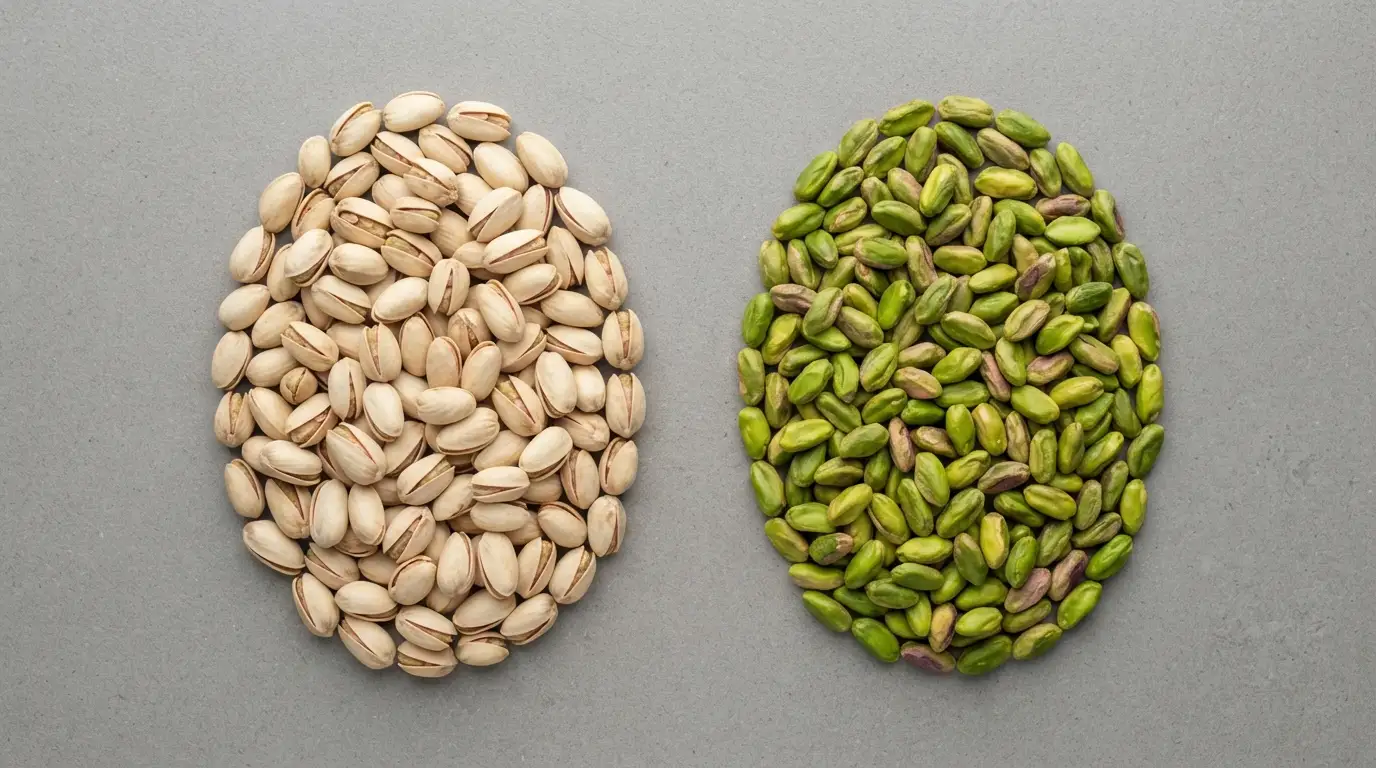
The in-shell trade and the kernel trade are two different businesses that happen to share a raw material. They have different customers, different quality criteria, different packaging, different shelf lives and different customs codes — in-shell pistachios clear under HS 0802.51, shelled under HS 0802.52. A buyer who is fluent in one is not automatically fluent in the other.
The confusion that costs money is almost always the same one: a purchase order that says "pistachio kernels, 1,000 kg" and assumes the supplier will infer the rest. What follows is the grade structure the Iranian trade actually works with, and what each grade is bought for.
Grade 1 — Whole natural kernel
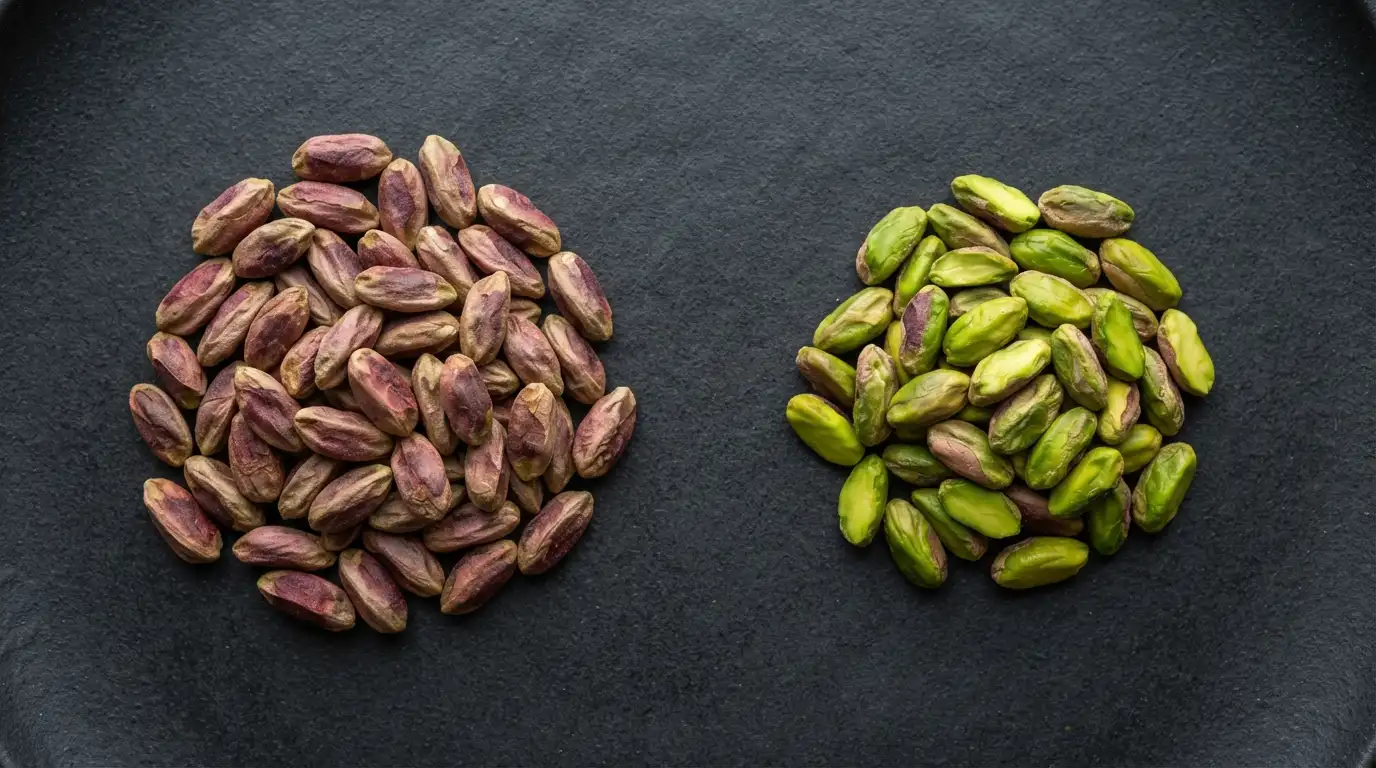
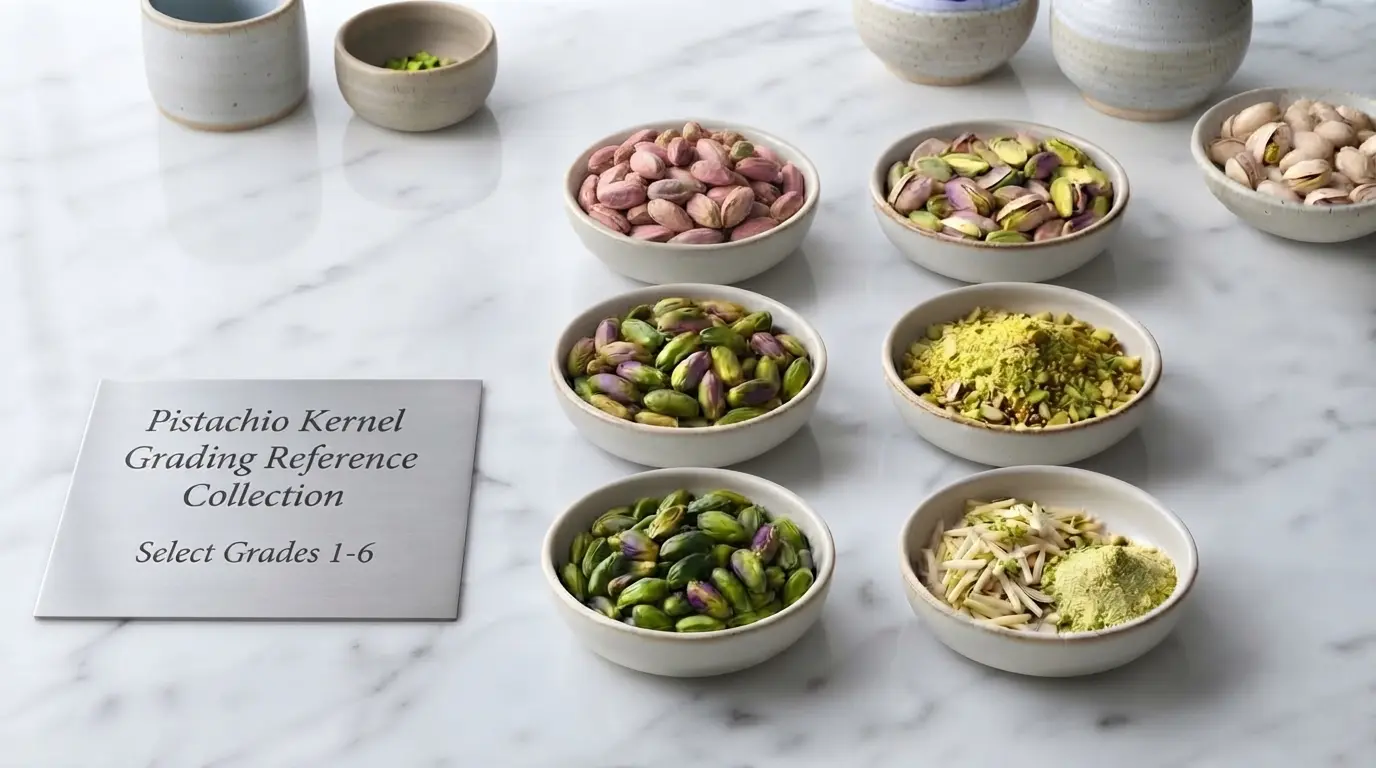
The baseline product: whole kernels with the skin left on, shelled from naturally open in-shell stock. The skin is a thin reddish-brown or purplish membrane, and it is why this grade looks nothing like the bright green product most people picture when they hear "pistachio kernel".
Colour varies naturally by variety and by harvest timing. Whole natural kernel is the workhorse of the category: snack packing, roasting and salting as a shelled snack, ice cream inclusion where the skin is not a problem, bakery use where the kernel will be chopped anyway. It is the least expensive whole-kernel grade and it is the correct choice whenever the skin does not matter.
Grade 2 — Green peeled kernel
The same kernel with the skin removed, usually by blanching followed by mechanical peeling and re-drying. Underneath the skin the kernel is green, and this grade exists because that green is worth paying for.
Green peeled kernel is the standard ingredient for anything where the pistachio has to look like a pistachio in the finished product: baklava and Middle Eastern pastry, nougat and torrone, chocolate inclusions, decorative topping, high-end ice cream. The peeling step adds cost and adds handling, and both show up in the price.
It also introduces a real risk that buyers should ask about. Blanching reintroduces moisture, and if the re-drying step is rushed or the product is packed warm, the kernel arrives soft and its shelf life collapses. When you buy peeled kernel, ask for the moisture result on the finished product, not on the input.
Grade 3 — Early-picked kernel
Known in the Iranian trade as kal or boz, this is kernel harvested deliberately before full maturity, when the chlorophyll content is at its highest and the kernel is at its most intensely green. It is peeled and dried with particular care because the colour is the entire product.
This is the most expensive kernel grade Iran produces and the volumes are small, because the grower is trading yield for colour — an early-picked kernel weighs less than the same kernel would have at full maturity. It is bought by confectioners for whom colour is a brand signature: premium baklava houses, pistachio pastes and creams where the finished colour is the selling point, and luxury ice cream.
If a supplier offers deep-green kernel at close to standard peeled-kernel prices, the colour is not coming from early harvest. Ask what it is coming from.
Grade 4 — Halves
Kernels split cleanly along their natural line into two halves. Some occur naturally during shelling; the rest are produced deliberately. Halves are used where a visible pistachio piece is wanted but a whole kernel would be too large or too expensive — chocolate bars, biscuit toppings, cereal and snack bars, mixed-nut confectionery.
Commercially, halves are the value grade: much of the visual benefit of a whole kernel at a materially lower price. If your application does not require an intact kernel, this is usually where the sensible purchase sits.
Grade 5 — Pieces and granules
Broken kernel, sized by screening into bands — coarse pieces down to fine granules. Pieces arise both as a by-product of handling whole kernel and as a deliberately produced grade.
They are bought by weight for flavour and texture rather than for appearance: bakery fillings, pastry layers, ice cream ripples, sauces, seasoning blends, industrial confectionery. Specify the particle size band you need, because "pieces" without a size specification can arrive as anything from near-halves to something close to meal.
One point worth knowing: pieces have proportionally more cut surface exposed to air than whole kernels, so they oxidise faster. A twelve-month shelf life quoted for whole kernel does not transfer to the pieces from the same lot.
Grade 6 — Slivers, sticks and flour
The processed end of the range. Slivers and sticks are kernels cut lengthwise into thin strips, used almost entirely as decoration — the top of a cake, the edge of a pastry, garnish on a plated dessert. Pistachio flour or powder is finely milled kernel, used in doughs, fillings, macarons and ice cream bases where pistachio flavour is wanted without visible pieces.
Both are made from kernel that has already been peeled, so they carry the peeling cost. Flour in particular is fragile: the milling releases oil, and oil in contact with air is the beginning of rancidity. Buy flour in quantities you will use inside a few months, insist on vacuum or nitrogen-flushed packing, and do not treat the shelf life as equivalent to whole kernel.
Colour is the currency in the kernel trade
In the in-shell trade, size sets the price. In the kernel trade, colour does. This surprises buyers coming across from in-shell purchasing, and it changes what you should be asking about.
Green comes from chlorophyll, and chlorophyll degrades with maturity, with heat, and with time. That means kernel colour is produced by three decisions upstream of you: when the crop was picked, how gently it was dried, and how long and how warm it has been stored since. A supplier who can discuss all three specifically is describing their own process. A supplier who only says "our kernels are very green" is describing a photograph.
The practical protection is to buy against a physical reference. Agree a sealed retained sample with the supplier before shipment, keep half, and settle colour disputes against it. Colour is genuinely hard to specify in words and trivially easy to compare side by side.
Which grade for which application
Kernel grade by end use
Application | Usual grade | Why |
|---|---|---|
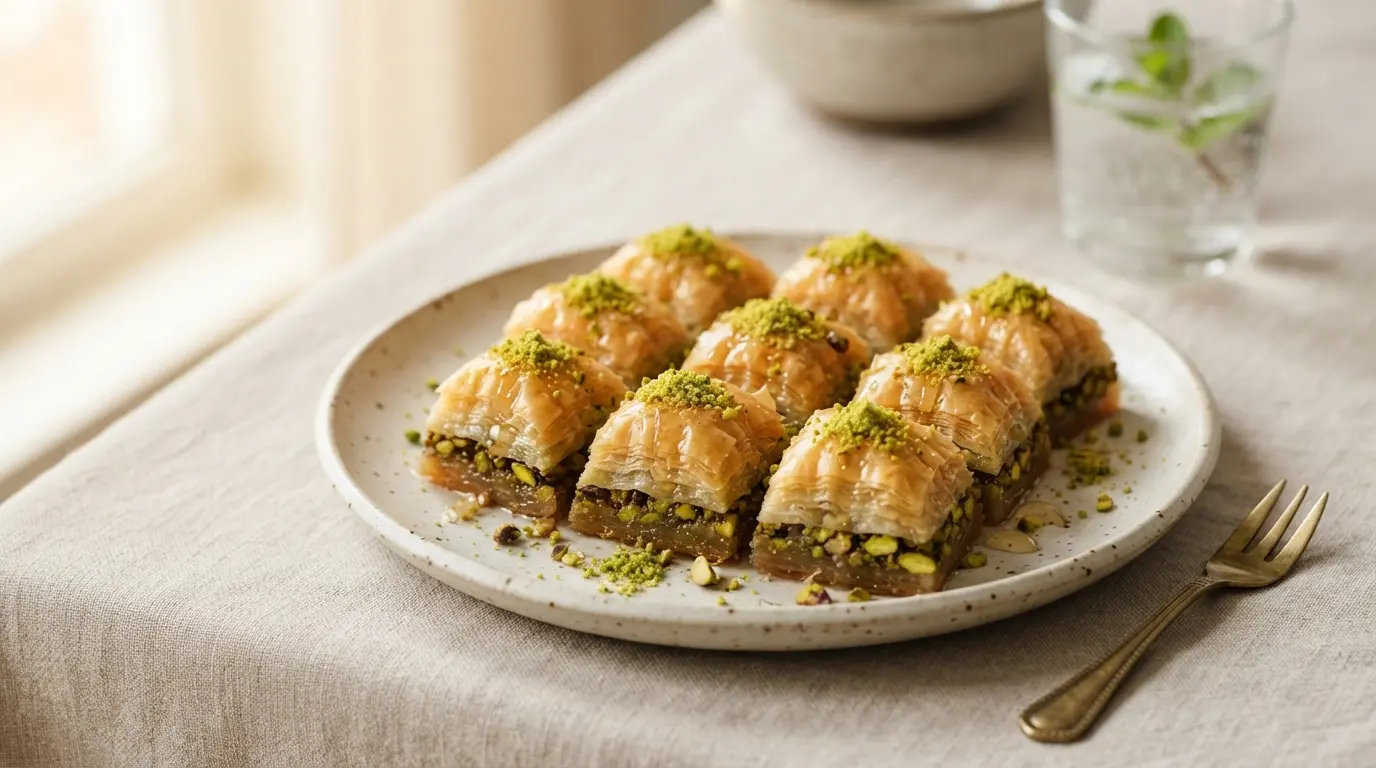
Baklava and Middle Eastern pastry | Green peeled; early-picked for premium lines | The pistachio is visible in the finished product and the colour is part of the identity of the pastry. |
Ice cream and gelato | Early-picked or green peeled for the base; pieces for inclusion | Base colour drives perceived quality; inclusions are eaten, not examined. |
Chocolate and confectionery | Halves and whole peeled | Needs a recognisable piece at a controlled cost per unit. |
Nougat and torrone | Whole peeled or whole natural | Kernels must survive the mix intact; skin is often acceptable. |
Bakery fillings and pastes | Pieces, granules or flour | Flavour and texture only; appearance is irrelevant once mixed. |
Cake and dessert decoration | Slivers and sticks | Cut for visual effect rather than for volume. |
Shelled snack packs | Whole natural, roasted and salted | Cost per pack governs; skin is expected by the consumer. |
The grading language on a specification
Iranian trade names describe what the kernel is. Formal grade standards describe how good it is, and the two are used side by side in international contracts. The most widely referenced framework for shelled pistachios sets out three grades — U.S. Fancy, U.S. Extra No. 1 and U.S. No. 1 — with defect tolerances applied by weight.
Defect tolerances by grade, shelled pistachio kernels
Tolerance (by weight) | U.S. Fancy | U.S. Extra No. 1 | U.S. No. 1 |
|---|---|---|---|
Damage | 2.0% | 2.5% | 3.0% |
Serious damage | 1.5% | 2.0% | 2.5% |
Insect damage (within the above) | 0.3% | 0.4% | 0.5% |
Foreign material | 0.03% | 0.05% | 0.1% |
United States Standards for Grades of Shelled Pistachio Nuts, §51.2557. Cited because these are the tolerances most international contracts reference, regardless of origin.
The same framework defines size and style classifications that are worth borrowing even when you are not buying American product. Jumbo whole kernels require 80 per cent or more by weight to be whole kernels, with not more than 5 per cent passing through a 24/64 inch round-hole screen. Large whole kernels require the same 80 per cent whole, with not more than 2 per cent passing a 16/64 inch screen. Large split kernels require 75 per cent or more to be half kernels split lengthwise. And where a lot is described as "very well dried", the average moisture content must not exceed 7 per cent.
Quoting a whole-kernel percentage is the single most useful thing a kernel buyer can add to a purchase order. "Whole kernels, minimum 85 per cent whole by weight" converts a vague expectation into a measurable one, and it is the clause that prevents a lot of halves and pieces arriving as "kernels".
Aflatoxin: why kernels get more scrutiny
In-shell pistachios can be sorted. Optical and manual sorting removes stained, damaged and suspect nuts before shipment, and the shell itself provides a physical barrier. Kernel has neither advantage: the protective layer is gone, and a contaminated kernel cannot be identified as reliably once it is out of the shell and mixed into a lot.
Regulators price that difference into their limits. Under EU rules, pistachios intended to be sorted or otherwise physically treated before human consumption may carry up to 12.0 µg/kg aflatoxin B1 and 15.0 µg/kg total aflatoxins. Pistachios placed on the market for the final consumer — ready to eat — must not exceed 8.0 µg/kg B1 and 10.0 µg/kg total. Most kernel destined for direct food use falls under the stricter figures.
What that means for a purchase order: name the limit you need, name the sampling standard, and require the certificate of analysis to be lot-specific and dated. A generic laboratory report attached to a series of shipments is not a result for your container. And if you are buying peeled kernel, remember that peeling reduces surface contamination but does nothing about aflatoxin already inside the kernel — the test still has to be run on the finished product.
Packaging and shelf life
Kernel is more fragile than in-shell product in every respect that matters. The shell is a mechanical protector, a light barrier and an oxygen barrier all at once, and removing it removes all three.
Vacuum packing is not optional for kernel intended for anything other than immediate processing. Ten to twelve and a half kilogram vacuum bricks inside export cartons are the standard format.
Temperature during transit matters more than for in-shell. A kernel container standing on a quay in Gulf summer heat is losing colour and gaining oxidation every day it sits there.
Green peeled and early-picked grades fade. Colour is the value; heat and light take it. If the product is worth a premium, it is worth a temperature-controlled leg.
Pieces, slivers and flour have shorter lives than whole kernel from the same lot, because cutting and milling multiply the exposed surface. Do not let a supplier quote you one shelf life across the whole range.
Ask what the packing moisture was, not what the specification allows. The two are frequently not the same number.
The purchase order lines that prevent arguments
A kernel specification that will hold up contains these lines. Anything missing will be resolved in the supplier's favour, not yours.
Grade by trade name — whole natural, green peeled, early-picked, halves, pieces, slivers or flour.
Whole-kernel percentage, by weight, where the grade is a whole-kernel grade.
Particle size band, where the grade is pieces or granules.
Colour, agreed against a sealed retained sample rather than described in words.
Maximum moisture content on the finished packed product.
Defect tolerances, referenced to a named standard rather than left to interpretation.
Aflatoxin limit, sampling standard, and a requirement for a lot-specific dated certificate of analysis.
Packing format, net weight per unit, and whether vacuum or nitrogen flush.
Crop year.
Questions buyers ask
What is the difference between green peeled pistachio kernel and ordinary kernel?
Ordinary whole natural kernel keeps its thin reddish-brown skin. Green peeled kernel has been blanched and mechanically peeled to expose the green kernel underneath, then re-dried. The peeling adds cost and handling, and the green colour is what buyers are paying for.
Why is early-picked kernel so much more expensive?
Because the grower harvests before full maturity to capture maximum chlorophyll, and an immature kernel weighs less than a mature one. The premium pays for the yield the grower gave up, plus the more careful drying the colour requires.
What moisture content should pistachio kernels have?
Under the widely referenced US standard, a lot described as "very well dried" must have an average moisture content not exceeding 7 per cent. Ask for the figure measured on the finished packed product — particularly for peeled grades, where blanching reintroduces moisture that has to be driven off again.
Which kernel grade should I buy for ice cream?
For the base colour and flavour, early-picked or green peeled kernel, usually milled or made into paste. For visible inclusions, pieces in a specified size band. Using premium peeled kernel for inclusions that will be chewed rather than looked at is a common and expensive mistake.
What is the HS code for pistachio kernels?
Shelled pistachios, fresh or dried, fall under HS 0802.52. In-shell pistachios fall under HS 0802.51. Confirm the national extension of the code with your customs broker, as duty rates are set at that level, not at the six-digit heading.
How long do pistachio kernels keep?
It depends on the grade and the packing. Whole kernel, vacuum packed and stored cool and dark, holds well for around a year. Pieces, slivers and flour have materially shorter lives because milling and cutting expose far more surface to oxygen. Treat any single shelf-life figure quoted across the whole range with suspicion.
Ready to place an enquiry? Contact our export team for a firm quotation on this specification. Browse our pistachio kernel products for current grades and availability.