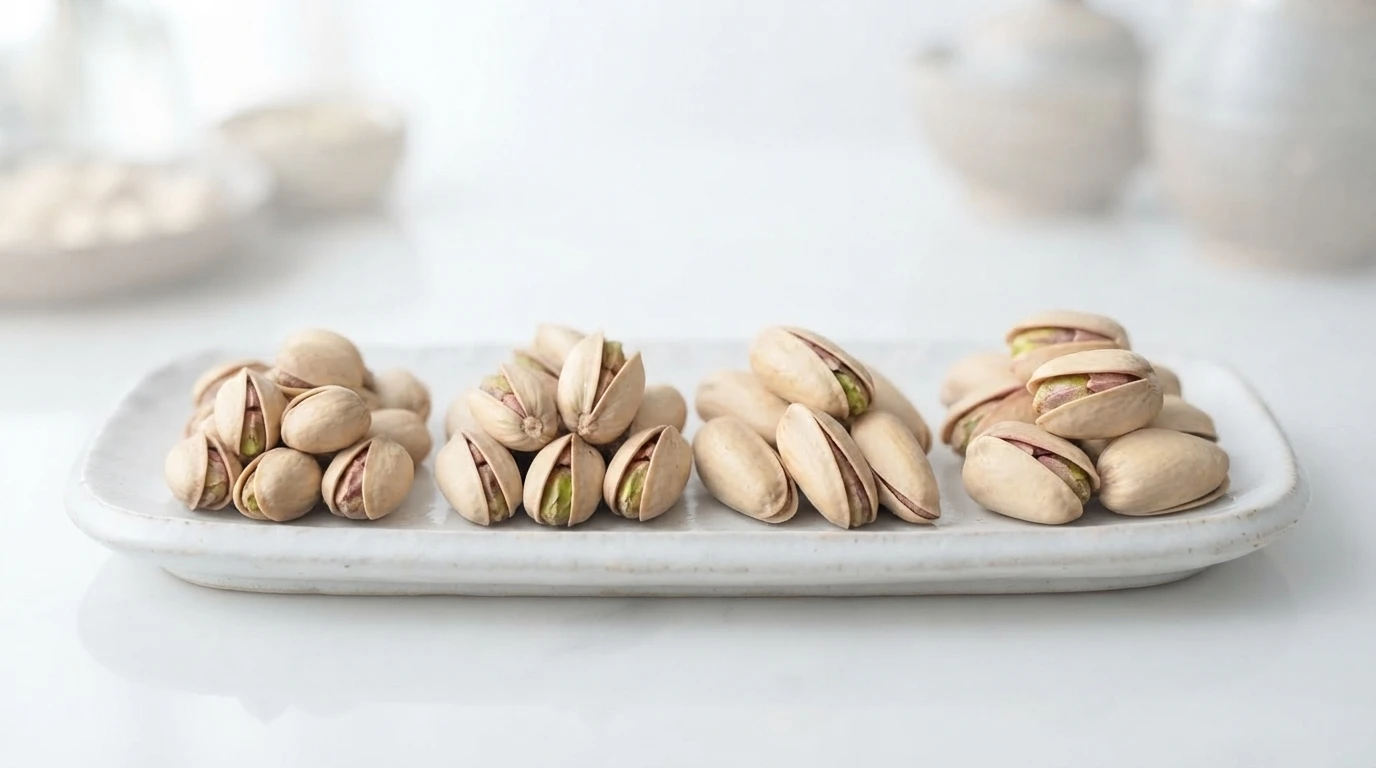
Natural Open, Mechanical Open and Closed Shell: What the Difference Actually Costs You
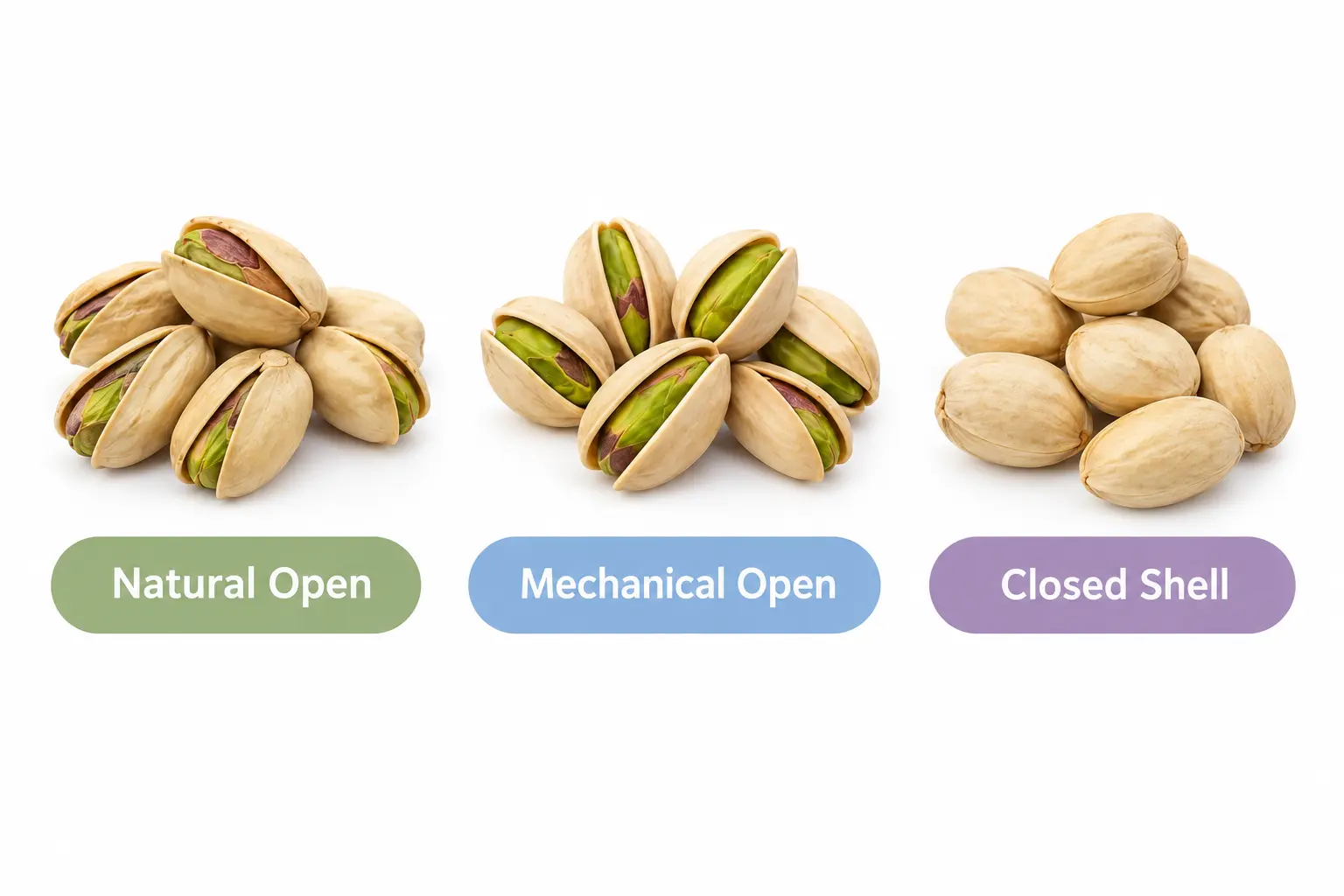
Two lots of the same variety at the same size can differ in price by a wide margin and both quotations can be honest. Shell form is usually the reason — and it is the line most often left vague in an enquiry.
A pistachio splits on the tree because the kernel inside grows large enough to force the shell apart along its seam. That is the whole mechanism, and almost everything commercially interesting about shell form follows from it. A nut that opened by itself is telling you something about the kernel inside it. A nut that was opened by a machine is telling you something too — just not the same thing.
This article covers the three forms you will be quoted, how to tell them apart in a sample, and the arithmetic that decides whether a discount on mechanically opened product is actually a discount.
Naturally open
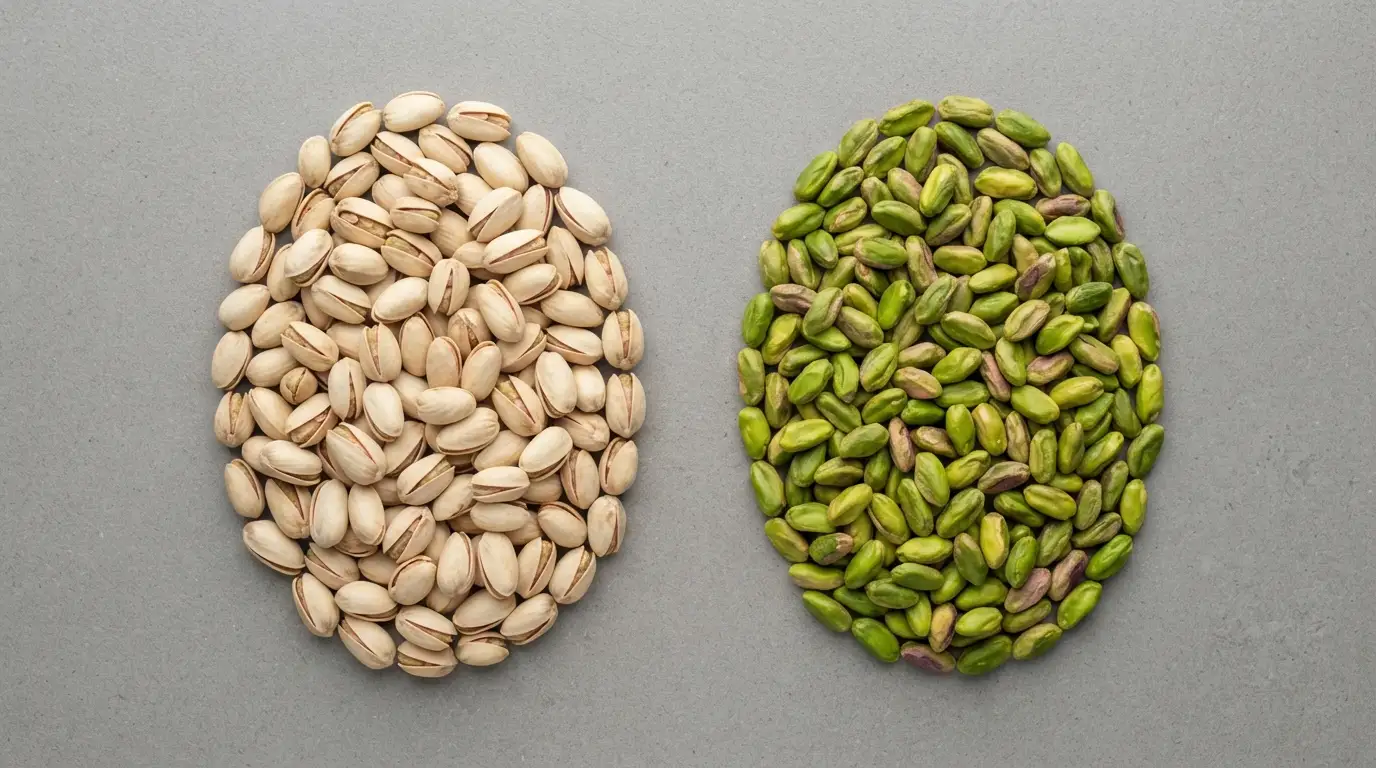
A naturally open nut — often written NO on a specification, and khandan in the Iranian trade — split on the tree during the final weeks of ripening. The kernel filled the shell cavity and the shell gave way along its natural suture.
The commercial significance is that the split is evidence, not decoration. A shell that opened on its own contained a kernel large enough to open it, which is why naturally open lots typically carry a kernel-to-shell ratio above 53 per cent. The split itself is clean: it follows the seam along the length of the nut, the edges are smooth and slightly rolled, and the two halves remain firmly attached at both ends.
This is the product that goes into gift packing, premium retail, and any channel where the consumer sees the nut before eating it.
Closed shell
Closed shell — dahan-baste in Persian, literally "shut mouth" — is the fraction of the crop that never split. It is a normal output of every orchard, not a fault, and every harvest produces some.
Two things happen to it. Most is shelled and enters the kernel trade, where the shell is irrelevant because it is being discarded anyway. The rest becomes the raw material for mechanical opening, which is the subject of the next section.
Where closed shell becomes a problem is when it arrives inside an in-shell contract. A consumer who buys a bag of in-shell pistachios and finds unopened nuts in it will not buy that brand again, and the retailer knows it. Every in-shell purchase order should therefore carry a cap on closed-shell content — a maximum of two per cent by weight is a reasonable line to hold, and up to five per cent is what you will often be offered. Without a stated cap you have no basis for a claim, because closed-shell nuts are not defective in any technical sense; they are simply the wrong product for that contract.
Mechanically opened
Mechanical opening — MO on a specification — takes closed-shell stock and forces it open under mechanical pressure. The finished nut looks, at a glance and from a distance, like a naturally open one. Up close it does not.
The important point is what the raw material was. Closed-shell nuts did not open on the tree, and the most common reason a pistachio does not open on the tree is that the kernel inside never grew large enough to force it. Mechanical opening therefore works on a population of nuts that is, on average, less well filled than the naturally open population from the same orchard. The reported outcome is a kernel-to-shell ratio that drops below 50 per cent, against above 53 per cent for naturally open product.
Mechanically opened pistachios are a legitimate product with a real market. They are not a fraud, and a supplier who offers them openly and prices them accordingly is behaving correctly. The problem in this trade is not the existence of MO — it is MO blended into an NO lot and sold as NO, which is a routine way of shaving cost, and which is invisible to a buyer who does not know what to look for.
The arithmetic that decides whether the discount is real
Buyers usually evaluate an MO offer by comparing the price per kilogram of in-shell product. That comparison is wrong, because you are not buying shell. You are buying kernel, wrapped in shell, and the shell is packaging you pay freight on.
Work it through with index numbers rather than currency. Take the naturally open price as 100 per kilogram of in-shell product, at a kernel ratio of 53 per cent. One kilogram of that lot delivers 530 grams of kernel, so the effective cost of a kilogram of kernel is 100 divided by 0.53, or 188.7.
Now take the mechanically opened lot at 48 per cent kernel. To land at the same effective kernel cost of 188.7, the in-shell price would have to be 188.7 multiplied by 0.48, which is 90.6. In other words:
Break-even discount on mechanically opened product
Naturally open | Mechanically opened | Difference | |
|---|---|---|---|
Kernel-to-shell ratio | above 53% | below 50% (48% assumed) | — |
In-shell price index | 100.0 | 90.6 | −9.4% |
Kernel delivered per kg in-shell | 530 g | 480 g | −50 g |
Effective cost per kg of kernel | 188.7 | 188.7 | break-even |
Ratios are the commonly reported industry figures for the two shell forms. The index is arbitrary; the relationship between the numbers is not.
A mechanically opened lot has to be roughly nine and a half per cent cheaper simply to break even on kernel content — before you account for appearance, shelf life, or the fact that you are paying ocean freight on additional shell weight. A five per cent discount on MO is not a discount. It is a price increase presented as a saving.
Telling them apart in a sample
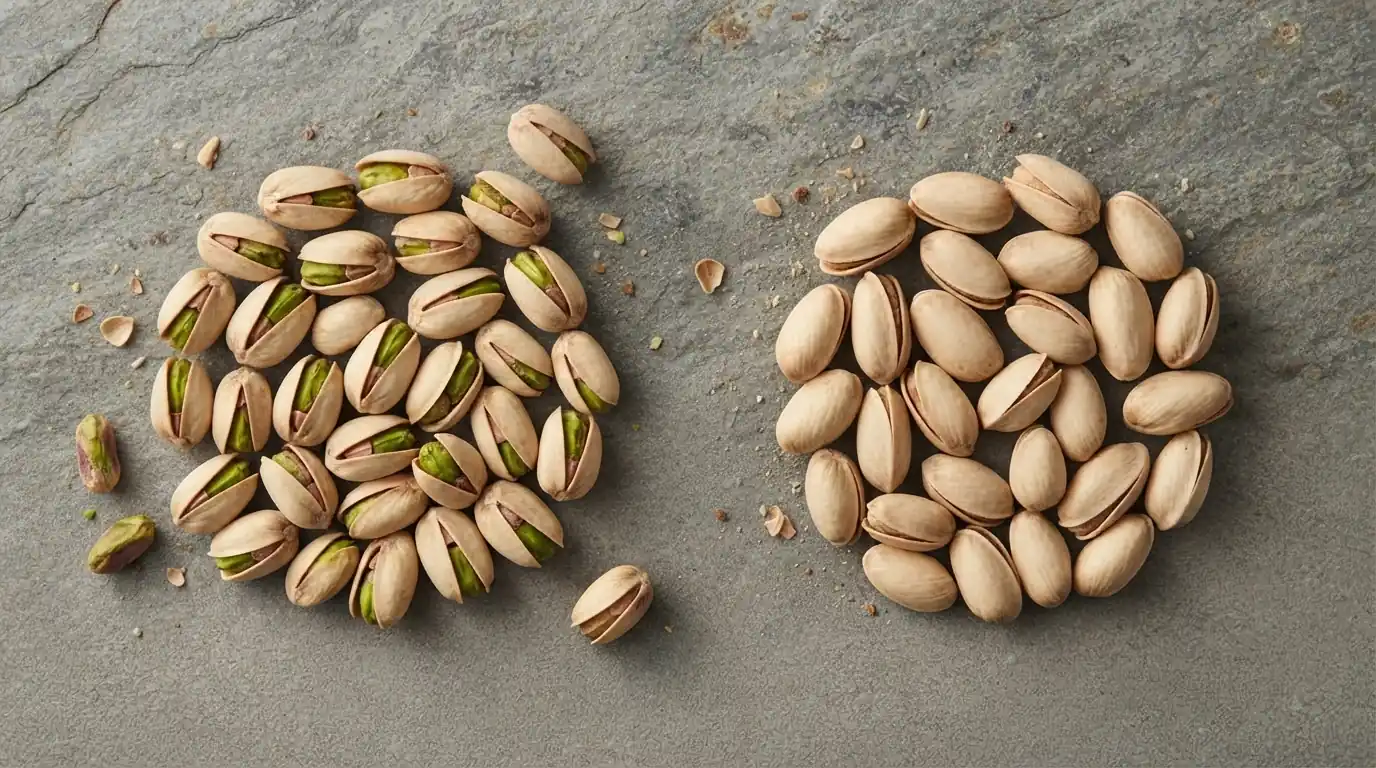
Most buyers can learn to separate the two by eye in about twenty minutes of practice. The signs are consistent.
Visual and physical differences
What to look at | Naturally open | Mechanically opened |
|---|---|---|
Line of the split | Follows the shell seam cleanly along the length of the nut | Often crosses or ignores the seam; may run at an angle |
Edges of the opening | Smooth, slightly rolled, no flaking | Chipped, ragged, sometimes flaked or crushed |
Shell integrity | Two halves attached firmly at both ends | Secondary cracks common; halves sometimes loose at one end |
Loose material in the bag | Minimal shell dust | Noticeably more shell fragments and free kernels at the bottom |
Kernel fill | Kernel fills the cavity, visible along the length of the split | Kernel often sits below the opening with visible empty space |
Kernel surface | Clean, no pressure marks | May show flattening or press marks where force was applied |
Uniformity across the lot | Splits vary naturally in width | Splits often unnaturally similar in width and position |
The counter-intuitive tell. Uniformity is the giveaway most buyers miss. Nature produces variation; a machine produces consistency. If every nut in the sample has an opening of almost exactly the same width in almost exactly the same place, that regularity was manufactured. |
A twenty-minute incoming test
Nothing here needs equipment beyond a kitchen scale that reads to a tenth of a gram.
Draw samples from at least five cartons taken from different positions in the container, not from the door. Combine and mix.
Weigh out 200 grams. Separate by hand into three piles: naturally open, mechanically opened, and closed shell. Weigh each pile and express it as a percentage of 200 grams. This is your shell-form breakdown and it takes about ten minutes.
From the same sample, take exactly 100 nuts and record their total weight. Shell them, weigh the kernels alone, and divide. That figure is your kernel-to-shell ratio, and it is the number that determines what you actually paid per kilogram of edible product.
Photograph the scale for each reading, with the sample visible in frame. Undated verbal descriptions are worth very little in a dispute.
Keep a retained sample from every container in a sealed bag with the container number and date on it. It costs nothing and it settles arguments.
If the kernel ratio comes back below 50 per cent on a lot sold as naturally open, you have a factual finding rather than an impression, and the conversation with the supplier changes character entirely.
Where mechanically opened product genuinely fits
None of this makes MO the wrong purchase. It makes it a purchase that has to be priced correctly and placed in the right channel.
Roasted and salted snack programmes where the nut is consumed quickly and the buying decision is made on price per pack rather than on the appearance of individual nuts.
Price-led volume markets where the alternative is not a better pistachio but no pistachio, because the shelf price point will not carry naturally open product.
Blends and mixed nut packs, where pistachios are one component among several and no single nut is examined.
Where it does not fit: gift packaging, premium retail, anything sold on the appearance of the nut, and any programme where the end customer is likely to compare your pack against a competitor's side by side.
There is also a shelf-life consideration that rarely appears in offers. A forced opening leaves more kernel surface exposed and can leave micro-cracks through the shell, both of which accelerate oxidation. MO product is best moved through the chain faster than NO product, and vacuum packing matters more for it, not less.
What to put in the contract
The shell-form line is short and it prevents most of the disputes in this category.
"Shell form: 100% naturally open. Maximum 2% closed shell by weight. Mechanically opened product not accepted. Minimum kernel-to-shell ratio 52% verified on a 100-nut sample at destination."
If you are buying MO deliberately, say so explicitly and specify the ratio you expect rather than leaving it open: "Shell form: mechanically opened, minimum kernel-to-shell ratio 47%." A supplier who will not put a ratio figure in writing is telling you the ratio is not one they want measured.
Questions buyers ask
What does NO and MO mean on a pistachio quotation?
NO is naturally open — the shell split on the tree as the kernel grew. MO is mechanically opened — closed-shell nuts forced open under pressure after harvest. The two are different products at different prices and should never be quoted as interchangeable.
Are mechanically opened pistachios lower quality?
They are made from nuts that did not open naturally, which usually means the kernel is less well filled. Reported kernel-to-shell ratios run below 50 per cent against above 53 per cent for naturally open product. Whether that constitutes lower quality depends on your channel; whether it justifies a lower price is not in question.
How much cheaper should mechanically opened pistachios be?
On kernel content alone, roughly nine to ten per cent below the naturally open price of the same variety and size is break-even. Anything less than that and you are paying more per kilogram of actual kernel, not less.
Can I tell mechanically opened pistachios apart just by looking?
Usually, yes. Look at the line of the split and the edges of the opening. A natural split follows the shell seam with smooth edges; a mechanical one is often irregular, chipped or unnaturally uniform across the whole sample. Loose shell fragments in the bottom of the bag are another reliable indicator.
Is closed shell a defect?
Not in itself. It is a normal fraction of every harvest and it has a legitimate destination in the kernel trade. It becomes a problem only when it arrives inside an in-shell retail contract, which is why the purchase order should cap it — two per cent by weight is a defensible limit.
Do suppliers mix the two?
It happens. Blending mechanically opened nuts into a naturally open lot is a known way of reducing cost, and it is difficult to detect at a glance. The protection is a stated kernel-to-shell minimum in the contract plus a 100-nut check at destination, both of which turn the question into a measurement rather than an argument.
Ready to place an enquiry? Contact our export team for a firm quotation on this specification.