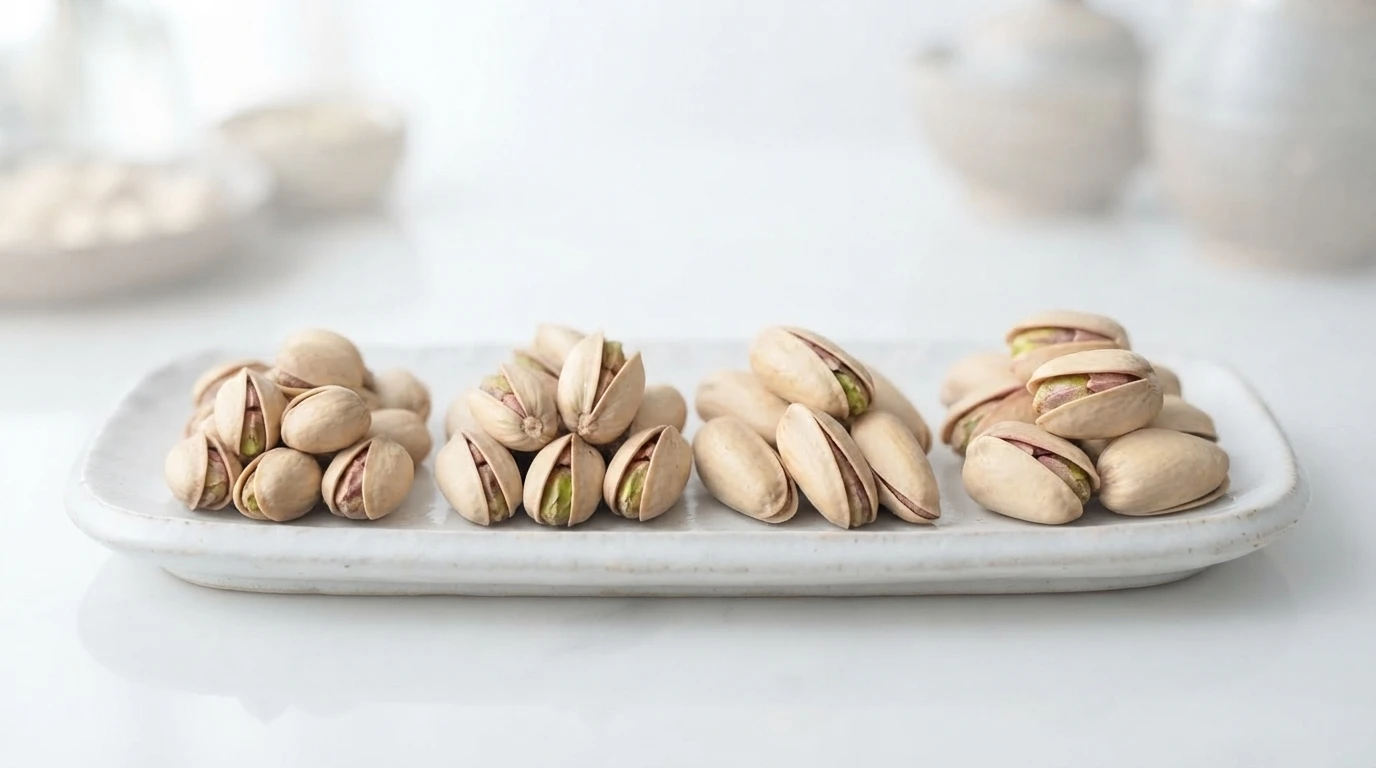
Pistachio Sizing Explained: What 20/22 and 26/28 Actually Mean
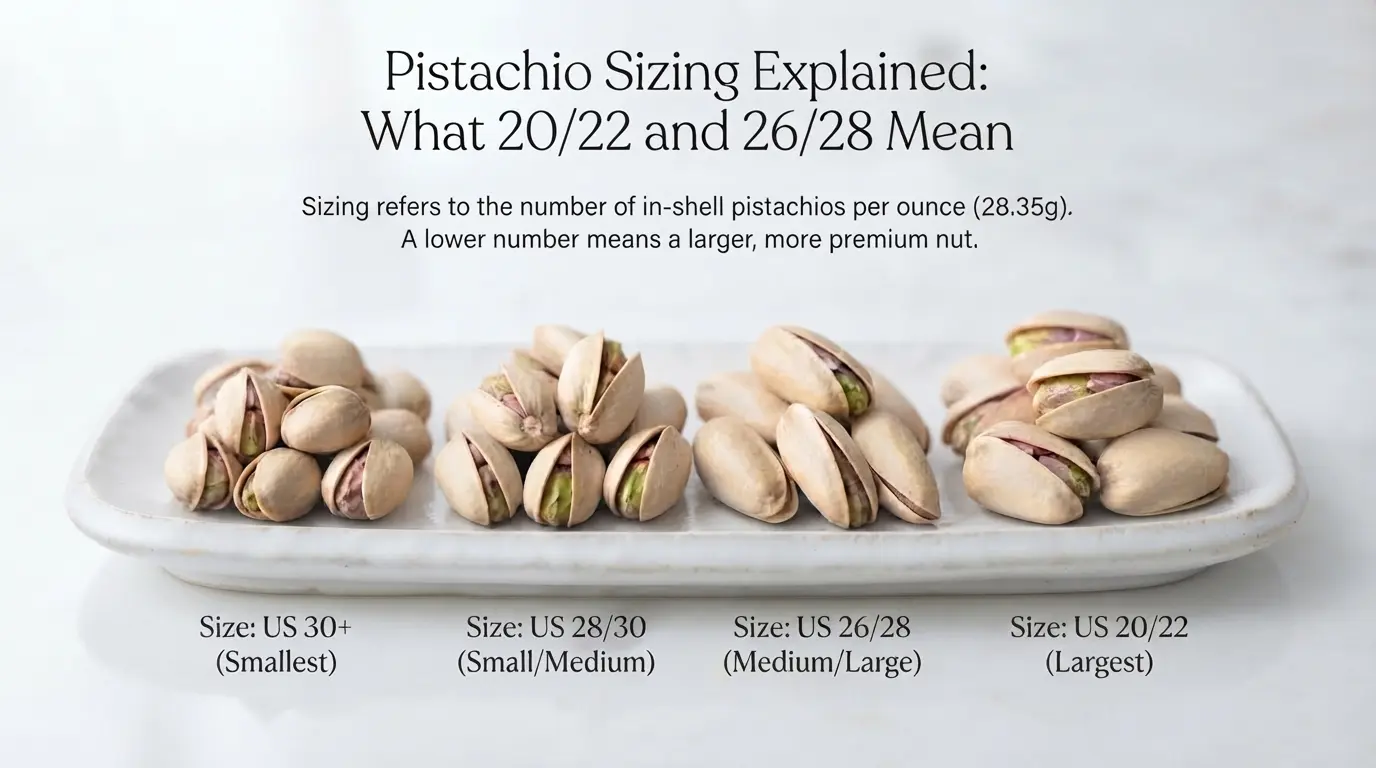
The size line is the most quoted and least understood part of a pistachio contract. It is also one of the easiest places for two quotations to look comparable when they are not.
Search for Iranian pistachios and you will find dozens of supplier pages describing size 22/24 as "kernels per pound". Some of them are large, long-established companies. They are all wrong, and the error is worth starting with, because it tells you something about how much of the technical copy in this trade is copied rather than checked.
A pistachio size is a count per ounce. Nothing else.
The convention
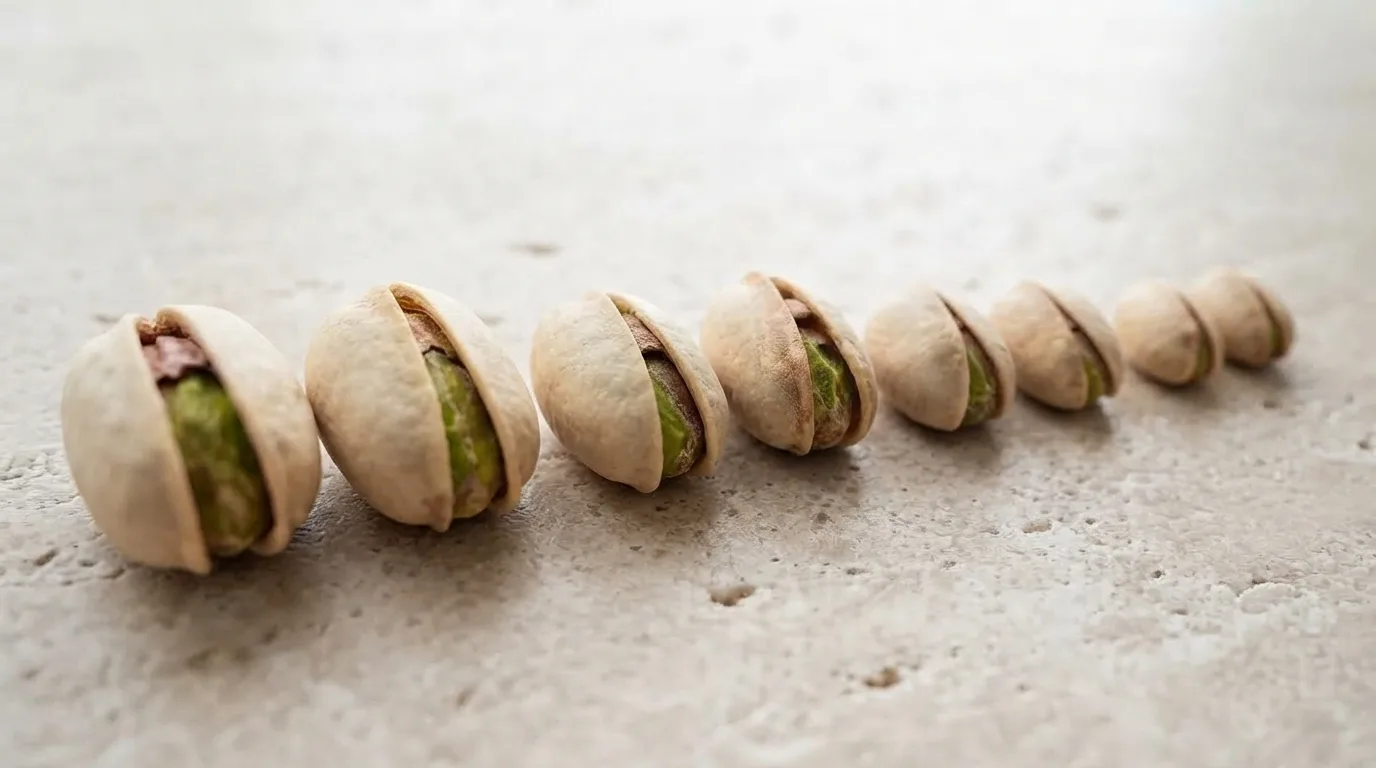
A size designation such as 22/24 means that one ounce — 28.35 grams — of that lot contains between 22 and 24 whole in-shell nuts. The lower the number, the fewer nuts it takes to make an ounce, and therefore the bigger each individual nut is. 18/20 is a very large pistachio. 32/34 is a small one.
It is expressed as a range rather than a single figure because no agricultural product grades to a single dimension. A screen deck separates nuts into a band; within that band there is natural variation, and the two numbers describe the edges of it. A supplier quoting a single number — "size 24" — is either simplifying or has not graded the lot properly, and it is worth asking which.
The ounce is a legacy of the American trade and it has stuck, including in contracts denominated entirely in kilograms and dollars. If it feels awkward, the conversion below removes the awkwardness permanently.
The size ladder, converted into units you actually use
Most buyers think in kilograms and most pack specifications are metric, so the count per ounce is a number you end up converting in your head. Here it is done once. One kilogram contains 35.274 ounces, so the nut count per kilogram is simply the count per ounce multiplied by that figure.
Size bands converted to nuts per kilogram and average nut weight
Size | Nuts per kilogram | Average nut weight | Commercial description |
|---|---|---|---|
18/20 | 635 – 705 | 1.58 – 1.42 g | Extra large. Small volumes only, Kalleghouchi and Akbari. |
20/22 | 705 – 776 | 1.42 – 1.29 g | Large. The premium retail and gift-box size. |
22/24 | 776 – 847 | 1.29 – 1.18 g | Large to medium. The most traded band overall. |
24/26 | 847 – 917 | 1.18 – 1.09 g | Medium. Strong value-to-appearance ratio. |
26/28 | 917 – 988 | 1.09 – 1.01 g | Medium to small. Common in mixed retail packs. |
28/30 | 988 – 1,058 | 1.01 – 0.95 g | Small. Snack channel and processing. |
30/32 | 1,058 – 1,129 | 0.95 – 0.89 g | Very small. Mostly Fandoghi, price-led programmes. |
32/34 | 1,129 – 1,199 | 0.89 – 0.83 g | Smallest commercial band. Kernel production input. |
Calculated on 1 oz = 28.35 g and 1 kg = 35.274 oz. Nut counts rounded to the nearest whole nut.
That third column is the one worth keeping. When a supplier sends a photograph of a sample instead of a graded count — which happens more often than it should — an average nut weight of around 1.2 grams tells you immediately that you are looking at something in the 22/24 to 24/26 region, whatever the label says.
Not every variety reaches every size
This is where enquiries most often go wrong. Size is bounded by variety. Asking for a band the variety does not produce in commercial quantity guarantees one of three outcomes: a silent variety substitution, a hand-picked sample lot at a price that will never repeat, or a quotation that simply never arrives.
Commercial size availability by variety
Variety | Standard commercial bands | Available in limited quantity |
|---|---|---|
20/22, 22/24, 24/26 | 18/20 | |
Akbari | 20/22, 22/24, 24/26 | 18/20 |
Ahmad Aghaei | 22/24, 24/26, 26/28, 28/30 | 20/22 |
Fandoghi (Round) | 28/30, 30/32, 32/34 | 26/28 |
"Limited quantity" means the variety produces it, but not in the volumes a container programme requires. Treat it as an availability question, not a price question.
The practical test. If a quotation offers you Fandoghi at 22/24, or Kalleghouchi at 30/32, the specification is wrong somewhere. Ask which. A supplier who corrects it in the next email is one worth talking to; a supplier who confirms it is one whose spec sheets you cannot rely on. |
How a size band is physically produced
Understanding the machinery explains why tolerance exists and why it varies between suppliers. After hulling and drying, in-shell pistachios pass across a stacked deck of vibrating screens with perforated plates. Each screen retains nuts above a certain dimension and passes the rest down to the next. The fraction retained on a given screen is a size band.
Two things follow from that. First, screens sort on width, not on weight or length — which is why a long variety and a round variety at the same nominal size are not identical objects. Second, screening is a mechanical process with a real error rate: some off-size nuts always carry through. A lot with two per cent off-size is normal; a lot with fifteen per cent has either been poorly graded or deliberately blended, and blending a cheaper band into an expensive one is one of the oldest margin tricks in the nut trade.
This is why the size line in a contract should be accompanied by a tolerance. A commonly workable clause is a maximum of five per cent by weight outside the stated band, with no more than two per cent falling more than one band below it. Whatever number you agree, put it in writing — an unqualified "22/24" gives you no basis for a claim.
What sizing does not tell you
Buyers new to the category sometimes treat the size band as a quality grade. It is not. It is one dimension of a specification and it is silent on everything that determines whether the lot is actually good.
Kernel content. A large nut with a thin kernel is worse value than a medium nut with a full one. Kernel-to-shell ratio is a separate line and it moves independently of size.
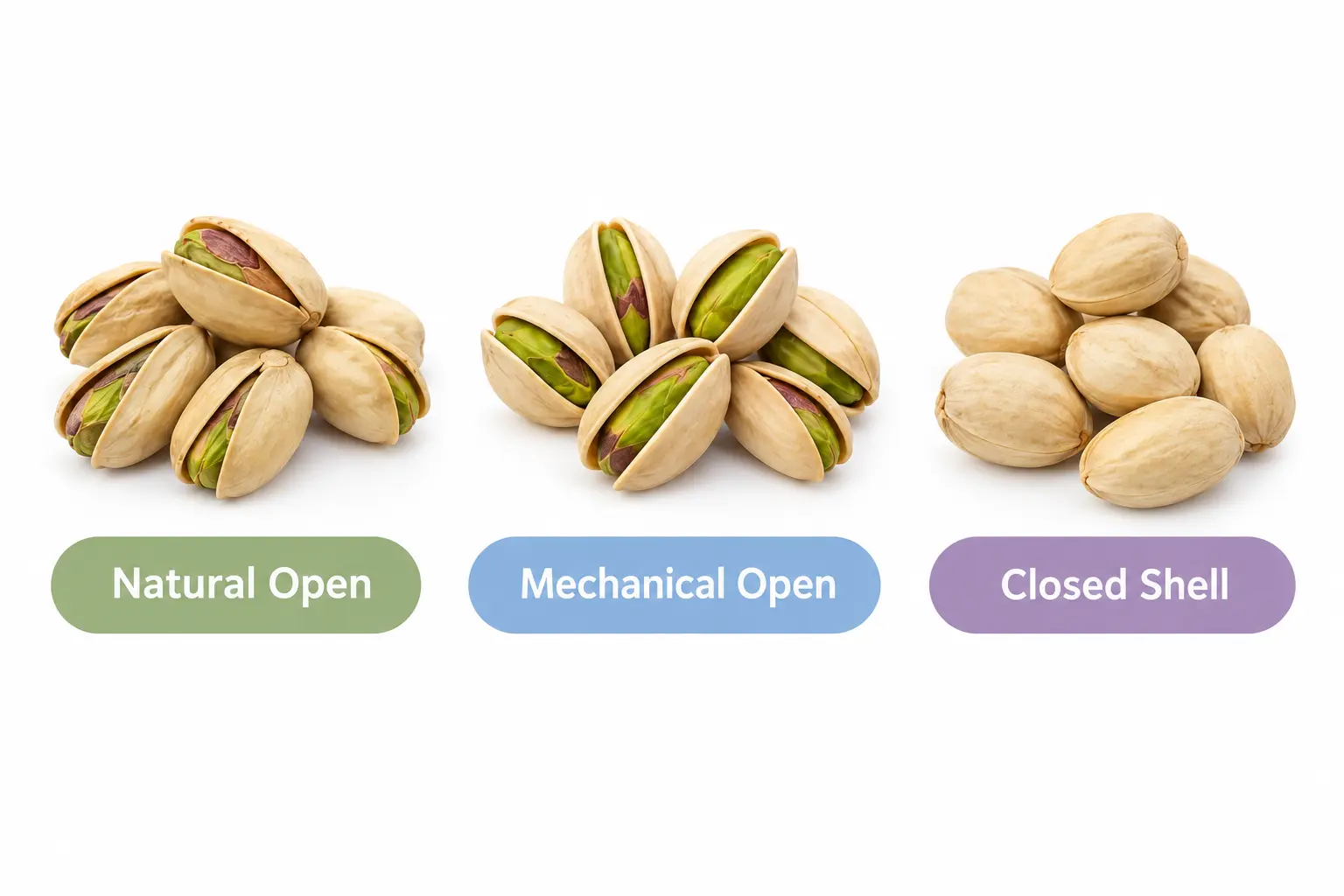
Shell form. A 22/24 lot can be naturally open, mechanically opened, or contain a significant closed-shell fraction. The price difference between those is larger than the difference between two adjacent size bands.
Moisture. Excess moisture inflates weight and shortens shelf life. Size is measured by count, so a wet lot is not a smaller lot — it is the same count of heavier, riskier nuts.
Defects. Staining, insect damage, adhering hull and shrivelled kernels are counted separately and none of them show up in the size line.
Colour. Shell whiteness and kernel green are graded by eye, not by screen, and they drive price at the retail end as much as size does.
A complete specification names all of these. A quotation that names only the size and the price is not a quotation you can compare against another one.
Iranian sizing next to other conventions
Buyers sourcing from more than one origin run into two other systems. American pistachios are usually described in words — Extra Large, Large, Medium — rather than in counts, and the boundaries are set by grade standards rather than by an ounce count. Some European and Turkish quotations are given per 100 grams, which is simply the ounce count multiplied by 3.5274.
When you are comparing a US offer against an Iranian one, convert both to average nut weight in grams and compare there. It is the only measure that is definitionally the same on both sides, and it removes an entire category of misunderstanding from the negotiation.
Checking size on an arriving lot
Verification takes about ten minutes and does not require any equipment you do not already own. Draw samples from at least five cartons spread across the container rather than from the door, since the door is where the good product is placed. Combine them, mix thoroughly, and draw a working sample of roughly 500 grams.
From the working sample, weigh out three separate portions of exactly 28.35 grams each and count the whole in-shell nuts in each portion. The three counts should sit inside the contracted band, and they should be close to each other — a spread of more than three nuts between portions means the lot is poorly graded even if the average happens to land where it should. Record the counts and photograph the scale display. A dated photograph of a reading is worth considerably more in a claim than a description of one.
Writing the size line
A size specification that will not be argued about later reads something like this: "Ahmad Aghaei, size 22/24 nuts per ounce, maximum 5% by weight outside band, maximum 2% more than one band below, crop year 2026." Five extra words, and they convert the size from an aspiration into an obligation.
Questions buyers ask
Does 22/24 mean nuts per ounce or per pound?
Per ounce. One ounce is 28.35 grams, so a 22/24 lot contains 22 to 24 whole in-shell nuts in that weight, or roughly 776 to 847 nuts per kilogram. Any source stating "per pound" is mistaken.
Is a bigger size always better?
Bigger is more expensive and, in display-led markets, more saleable. It is not inherently better. If the nuts will be shelled, roasted into a snack mix, or processed, size adds cost without adding value, and a smaller band with good kernel content is the better purchase.
Why do two suppliers quote very different prices for the same size?
Because size is one line out of six. Check variety, shell form (naturally open versus mechanically opened), closed-shell percentage, moisture, crop year and defect tolerance before concluding that one offer is cheaper than the other. In most cases the gap is explained entirely by shell form.
What off-size tolerance is normal?
Around five per cent by weight outside the stated band is workable for a well-run line. Anything approaching ten per cent suggests either poor screening or deliberate blending. Agree the figure in the contract rather than assuming a market norm.
How do I convert a per-100-gram size to a per-ounce size?
Divide by 3.5274. A count of 78 to 85 nuts per 100 grams is the same lot as 22/24 per ounce.
Can I order a mix of sizes in one container?
Yes. Specify each size as a separate line with its own net weight, and require the pallets to be marked by line. Mixing sizes inside a single carton is a different thing entirely and is almost never what you want.
Ready to place an enquiry? Contact our export team for a firm quotation on this specification.